Pepijn Trienekens, PhD candidate at the Radboud University and the IISH //
The history of slavery and colonialism receives growing attention in academic research, encouraged by a growing corpus of readily available source material through digitalization and text recognition software. Both legal and social historians have profited greatly from this process. Especially sources from colonial courts prove to be a shared ground of interrogation. Despite this common interests, interactions between us as social historians and our legal colleagues remain scarce. The workshop Colonial law, slavery and interactions organized at the International Institute of Social History (IISH) by the combined slavery research projects on 19 September 2025, provided us with a playground to share our insights on the intersections between slavery, colonial law and legal sources in the colonial archives. Eight historians shared their projects, imploring us to bridge historiographical distances towards further cooperation.
A first major theme of the workshop were studies exploring differences in legal traditions, namely Hylkje de Jong from the VU Amsterdam and Timo McGregor from Leiden University. De Jong discussed the HUF-project, which looks at legal frameworks in Holland, Utrecht and Friesland to explain and connect regional variations in law and local identities. De Jong explained her long-term goal of connecting HUF to colonial archives, for which the insights shared by Mcgregor seem particularly fitting. By comparing legal practices across the Caribbean, Mcgregor argued that they are reinterpretations of shared racial and political frameworks. These common practices and values spread through migrations and the transfer of colonies between empires, showing us how legal ideas and colonial practices moved across the Atlantic world.
Jacob Giltaij from the University of Amsterdam and Wouter Raaijmakers from the Radboud University further combined concepts with governance practices. Giltaij presented the role of Roman Law in colonial Curaçao, showing that legal ordinances and decisions often reflected Roman legal ideas. However, these ideas were rarely cited literally and were frequently applied opportunistically. Expanding his focus beyond the courtroom, he found that officials, slaveholders, and the revolutionary Tula all referenced Roman law, showing its importance in colonial societies. Raaijmakers took us through the idea of legal certainty in colonial contexts. He showed that the communication of law was often deliberately vague and its implementation presented an alarming lack of formal enactment of laws. This, he argued, demonstrates the illegal and ad hoc workings of the colonial legal system.
During the workshop the Early Modern Dutch Colonial Court Records database of Resilient Diversity project was launched. In their presentation of the dataset, Elisabeth Heijmans (IISH) and Sophie Rose (Leiden University) provided us with a bridge between the mostly conceptual legal-focused talks to approaches including individual experiences by introducing a database of court records from the WIC and VOC archives. This digital goldmine offers direct access to criminal and civil sources, opening new possibilities in researching legal practices and individual experiences, and proves a particularly relevant resource for all academics attending.
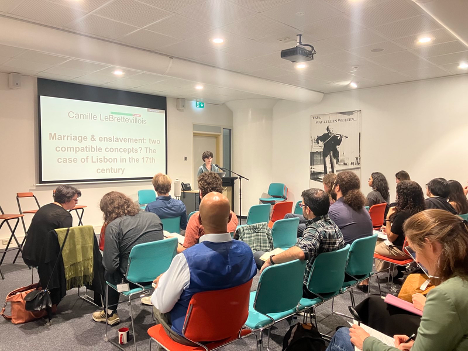
Joining in the theoretical bridge-building between our disciplines, Camille Le Brettevillois and Filipa Ribeiro da Silva of the IISH combined perspectives and actions of enslaved individuals with legal theories. Le Brettevillois talked us through marriage and slavery in seventeenth-century Lisbon. She explained how canon law, granting marriage as a right to all ‘good’ Christians, clashed with property rights over enslaved individuals. She emphasized that enslaved people were aware of their religious rights as they often mobilized networks of witnesses to their Christendom. In her presentation, Ribeiro da Silva flipped the top-down narrative of colonial law by showing how revolts and resistance shaped Portuguese legislation on slavery, demonstrating that these laws were responses to both the needs of lawmakers and actions from below.
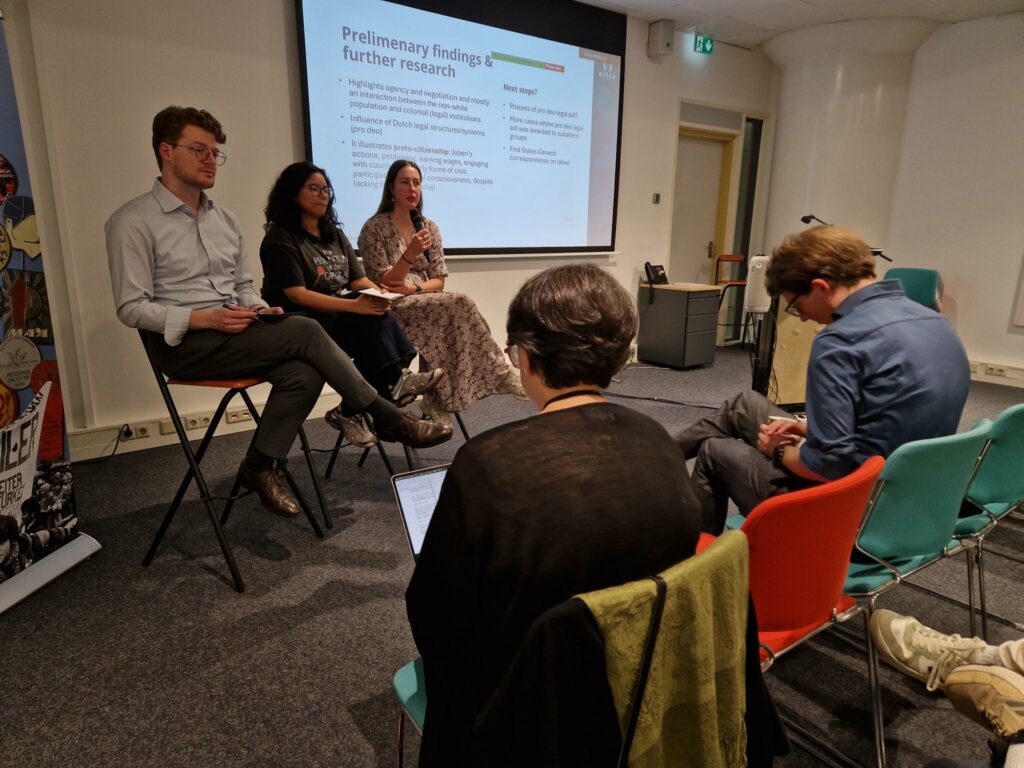
Finally, Ramona Negron and Mary-Anne Nicolaas of the KITLV shared their project How Slaves Became Citizens through case studies on legal agency of (illegally) enslaved people. Negron presented the story of Johanna. She was a free-born woman in Demerara who, after more than a decade of illegal enslavement under her adoptive guardians, successfully petitioned the colonial government for her freedom. Nicolaas introduced us to Jaberi, an enslaved woman in Suriname. Despite previously being informally manumitted, she was later abducted, imprisoned and claimed by a descendant of her deceased owner. After obtaining legal representation and navigating the court system, Jaberi was released and also able to petition her freedom. Johanna and Jaberi tell us much about subaltern experiences of colonial law on Demerara and Suriname. They show us the social status and rights-awareness of orphans and people of mixed descent in the Dutch Atlantic, and also the practices of shifting boundaries between enslavement and citizenship-rights.
Summing up the day, the importance of legal sources for social historians and for our legal colleagues is clear. The contributions showed how colonial law is not created in isolation but through continual negotiation, and that legal practices mattered more than merely the written law. To work towards a more complete picture of the creation, workings and uses of laws in colonial society, which is urgent for the study of slavery and colonialism as well as the history of law, we need both legal and social historians. Furthermore, as called for in the plenary discussion, we need to take indigenous legal traditions into our considerations and move away from a Eurocentric perspective focused only on colonial law imposed by European colonialists, but rather to see the impact of interactions between colonizers, colonized and otherwise affected societies.