Britt van Duijvenvoorde, PhD Researcher, International Institute of Social History, Amsterdam //
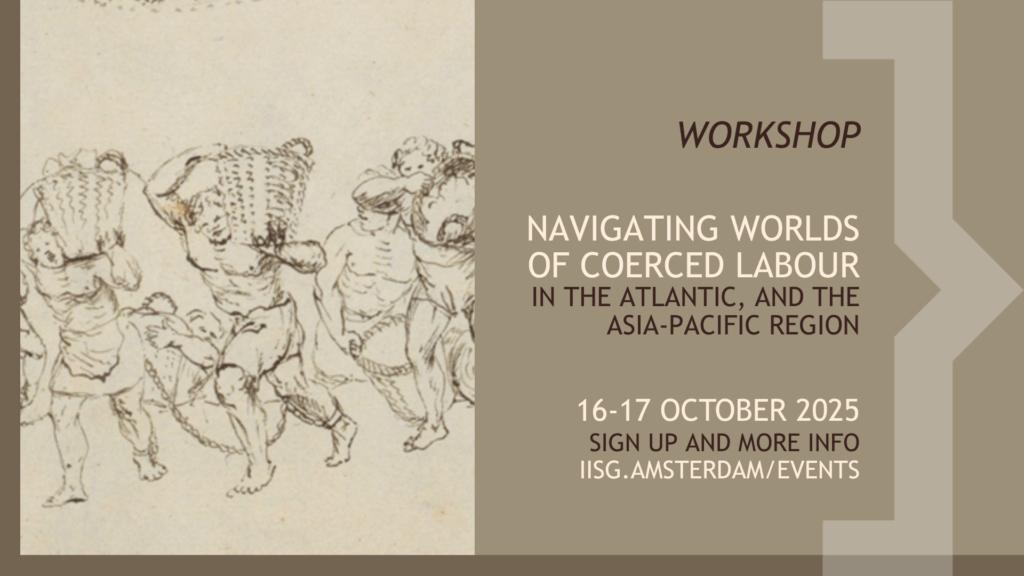
On the 16-17 October, the Workshop Navigating Worlds of Coerced Labour: Procurement, Mobility, Exploitation and Resistance of Enslaved, Indentured and Contracted Workers in the Atlantic, and The Asia-Pacific Region was held at the International Institute of Social History. Epitomized by the length of the workshop’s title, paper presentations were dedicated to a wide variety of coerced labor forms, ranging from slavery, indenture, and contract work in their varying temporal and spatial manifestations. Key questions and issues at stake concerned the different moments of the “supply-chain of coerced work” and the forms of resistance various actors enacted at these different moments within and against specific coerced labor strictures.
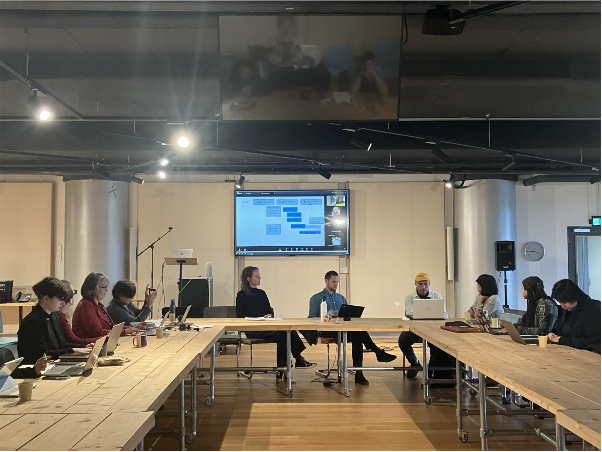
Any forced laborer’s trajectory starts with the moment of procurement or recruitment. Julia Godart’s paper was dedicated to the recruitment of Chinese laborers in the inter-imperial networks of China, France, and Britain from 1916 to 1923. Central to her paper were colonial infrastructures of recruitment: the physical impacts of ports, trains, and camps, and the physicality as well as the documentation procedures of the contract itself. Similarly drawing attention to recruitment structures, I (Britt van Duijvenvoorde) presented my ongoing research into enslavement in seventeenth century Bay of Bengal. I emphasized the convergence of different slavery regimes around this maritime space, ranging from local bondage systems to other local Asian as well as European commercial export slave trade and from warfare and raiding regimes to import-oriented slave trade. In Nicholas C. Sy’s paper, regions of export and import likewise intersected as he shared with us stories of how enslaved and free(d) individuals from Malabar, India, had been displaced throughout the sixteenth and seventeenth century to the Spanish Philippines and narrated their collective histories in terms of a Malabarian or “Malabares” identity. Jin Luo stressed the dialogue between state ideology and law enforcement in the case study of Tokugawa’s isolationist policies of 1635 on terminating the Japanese-European slave trade. Taking on a credo of ‘early modern emancipation through isolation,’ her work reminded the participants the importance of state interference and interest could clash with and impact commercial slaving projects. Taking on a more long durée perspective, Julio Machele’s paper’s presentation brought forward the persistence of structures of coerced labor recruitment by comparing models of nineteenth and twentieth century indentured servitude and contract labor of Mozambicans in Asia to the forced labor constructs that exist to this day.
Other paper contributions centered on the conditions of life and work at the moment of labor extraction. Michael Zeuske drew attention to the need to revisit the slave histories of commodity production on plantations in American and Caribbean with perspectives focused more specifically on labor. Through his presentation, filled with examples of different forms of labor performed by enslaved individuals, it became clear that the actual work those enslaved were forced to conduct remains often neglected in slavery studies. Hélder Carvalhal similarly drew attention to the fundamental realities of work of enslaved individuals in his presentation by looking at the intersection between empire-building and labor. His paper brought forward the idea that the Estado da Índia was able to develop and sustain itself (even in times of economic decline) due to a highly intensive extraction an allocation of non-European labour, particularly when compared with other European empires (Dutch, English) active in the Indian Ocean between 1510-1663 World. Concrete forms of work became connected to discursive formations in Titas Chakraborty’s paper, which revealed the complex historical manifestation of what, in practice, the social construct of “Portuguese” signified in an eighteenth century Bengali context. Amplifying the practical impact of discursive structures in contexts of colonial law, Matthijs Kraijo previewed his research into the impact of colonial governments’ laws and policies on shaping choices of repatriation or (re)settlement of indentured laborers from India in Surinam and Natal.
A third theme discussed during the workshop was resistance, a fact of life and labor at every moment in the “supply-chain of coerced work.” Teun van Kasteel and Jens Aurich presented their ongoing research into the acts of resistance by indentured laborers that can be found in the colonial Dutch East India Press between 1860-1940. By distinguishing resistance into three moments—entry, activities within the workplace, and exit—they developed a typology of resistance that spans practices from petitioning to sabotage to desertion. Falling within the same temporal and geographical span of van Kasteel and Aurich’s research, Koen van der Lijn’s paper focused on an 1889 miners’ revolt by Chinese workers on Bangka Island (Indonesia) who were put to work in Dutch-owned mines. His work revealed how the very documentation of the rebellion was a way in which these Chinese workers could push colonial administrators to rethink how they manage the coercive labor strictures they were entangled. Dércio Rodriques Nhamombe’s paper presentation revisited the region of Mozambique in 1899-1961, this time through the lens of resistance against new forms of modern Slavery. Similar to previous times, we learned of persisting forms of resistance such as fleeing, the singing of songs, committing sabotage, and engaging in physical, often violent, rebellions. Working within the same framework of resistance against renewed forms of colonial servitude after the abolition of slavery, Eric Tei-Kumadoe’s focused on resistance against forced labour recruitment for Gold Coast Mines in 1805-1950. His work drew attention crucial factors conditioning workers’ repertoire of resistance, such as the use of borders to escape imperial sovereignty, cross-border kinship and linguistic ties, and the position of local headmen, whose solidarity was crucial for the effectiveness of resistance.
From 1510 to 2025, and from Japan to Mozambique to the Caribbean, it was incredibly inspiring to see many works centered around many different geographies, timeframes, and forms of resistance. This was a great step towards fostering collaboration and stimulating dialogue between an array of scholars working on different forms of coerced labor and their bodies of literature. The closing roundtable once again emphasized the need for a shared research agenda that will allow scholars examining different forms of coerced labour relations to identify major similarities and differences, as well as shifts and continuities overtime, between different systems of coerced labor. One main takeaway from this session was the very framework in which coerced labor regimes are theorized. Commonly, these different regimes are denominated by virtue of their unique spatio-temporal manifestation: slavery, indenture, contract labor, modern forms of slavery or coerced labor. Yet the question is: if there is such a differential framework of understanding coerced labor, does this not a priori restrict us from establishing a detailed comparative framework?