Iliana Tintori Reyes, PhD Researcher, International Institute of Social History //
Old papers scattered on a wooden table, a latent past waiting to be discovered by the hands of the present, eager to unearth the ancient memory of what happened in other times and other places. For many historians, going to the archives represents a journey through time. Each historical source consulted acts as a door opening to the past; a threshold that allows us to glimpse a fraction of the experiences and problems that human beings faced. This journey, however, is not without challenges, frustrations, and purely physical issues.
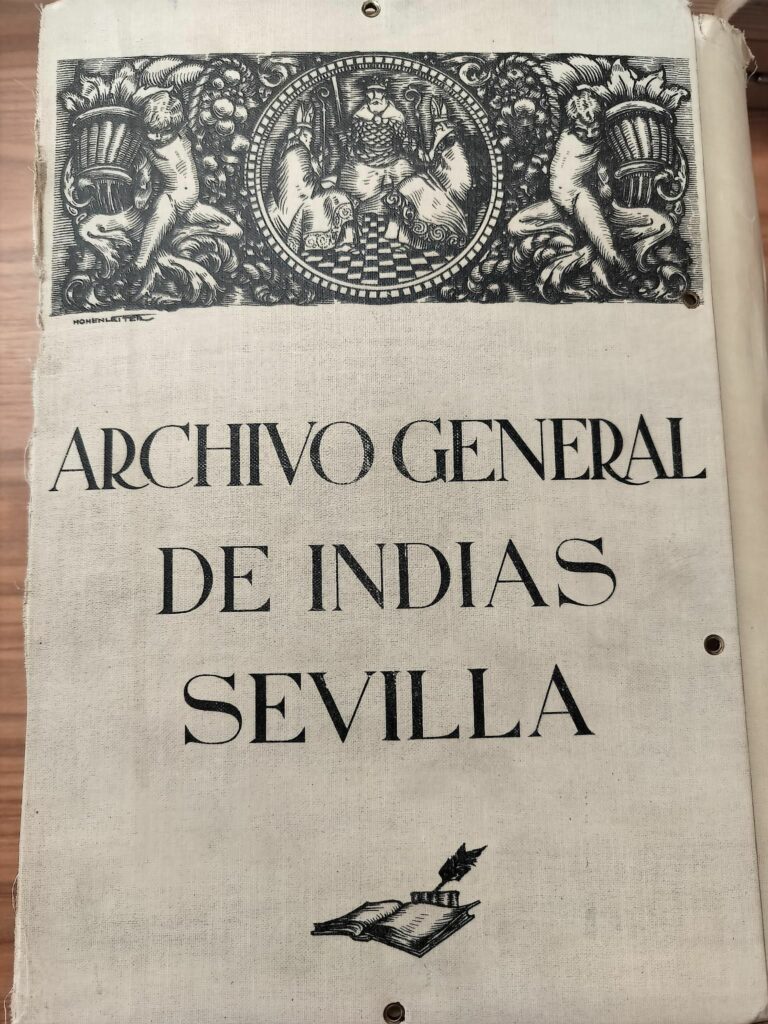
Today, in this blog, I would like to share and reflect on my experiences conducting research at the General Archive of the Indies (Archivo General de Indias, or AGI) in Seville. It is a place where history, patience, and curiosity coexist under the same roof, where each day promises a unique combination of discovery, adventure, or disappointment. Every time I visit this place, I feel like I am crossing the doorstep into a parallel world. Among the consultation tables and shelves containing numbered boxes of yellowed files, history seems to breathe at its own pace. There, where centuries of correspondence, litigations, inventories, and silences lie, one suddenly understands why this archive is one of the documentary gems for studying the Hispanic presence in Latin America and Asia. The AGI is the repository in which the voices of the empire, its colonies, administrators, merchants, travelers are intertwined, as are the voices of those who were enslaved – though often fragmented or distorted.
In one of my attempts to recover the past, I was suddenly struck by the capricious nature of the archives. I was researching the case of a Filipino man petitioning for his freedom (1657). Within the same inventory box that contained this source, I stumbled upon a similar case in which two enslaved individuals had requested their freedom, both from Tidore (1656). I initially thought that another box might contain their complete trial: witnesses, accusations, statements, etc. But when I opened more boxes, what I found was… only the sentence. A single sheet, taken out of context, as if time had deliberately taken away the pieces needed to complete the puzzle. It was a kind of ending without a beginning, a conclusion that refused to reveal its causes. There I was, trying to reconstruct a case that merely had a conclusion: no details of the conflict, no names of those involved, no motivation… just a verdict. This moment reminded me that, for historians, archival work is a constant mix of patience, intuition, realignment, and reassignment. Sometimes you might think you will find a treasure, but what you come across is just a partial hint, an incomplete echo. Other times, the opposite happens: an unexpected document appears and it opens up a completely different line of research.
Between the excitement of finding a document forgotten for centuries and the intriguing idea of unveiling a case that contradicts official versions and historiography, there are also the small daily battles, the fight against dust that triggers treacherous allergies just when you are trying to look professional; that awkward moment when a sneeze echoes in the silent reading room like a cannon shot in the midst of a calm. However, I would like to believe that these are also part and parcel of the job as a historian.
The archive is not just a physical space; it is also an ethical arena. Working with documentation related to slavery requires constant reflection on the historian’s positionality. Colonial documents rarely capture the direct voice of enslaved people; rather, they describe them from the perspective of power, reduced them to numbers, to property, to administrative problems. Engaging with this kind of sources means recognizing that one is reading absences, gaps, silences, and that one must approach them with care, sensitivity, and awareness of the historical inequalities that affected the existence and experiences of enslaved people. It is impossible to remain neutral: in interpreting and gathering these traces, the historian decides what to rescue, what to question, what to rewrite, and from where to do so.
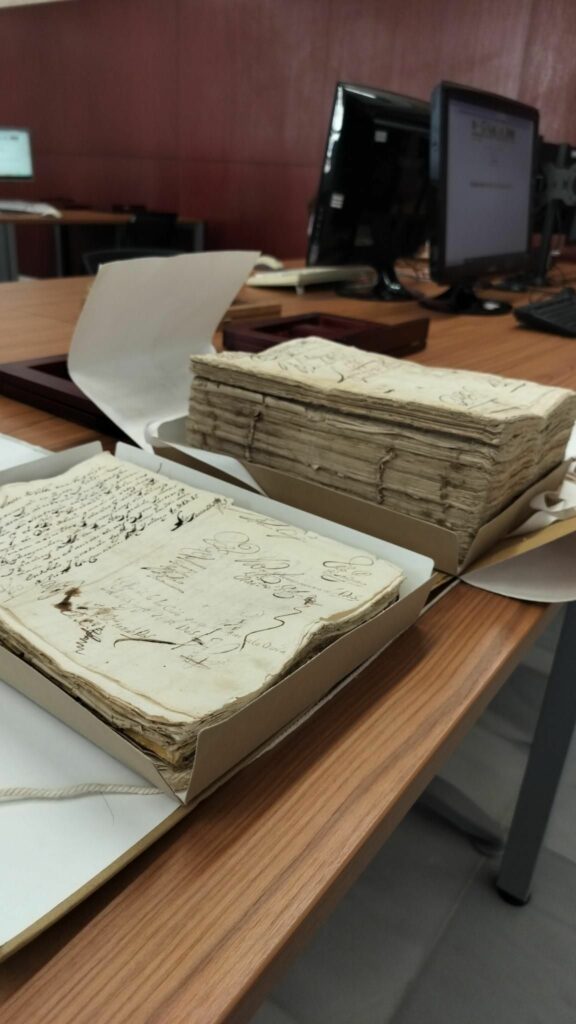
When I left the AGI behind after spending hours and hours among scattered papers and truncated clues, it made me better understand the strange profession I have chosen. Being a historian in the archive is like being a detective with no guarantee of solving the case, someone who pieces together possible narratives from fragments, intuitions, and documents that sometimes seem to be playing hide-and-seek. But it also means taking on the responsibility of bringing to life stories that would otherwise remain buried under layers of dust and silence. And, perhaps, that is the essence of the work: accepting that we are investigating an incomplete past, but still striving to reconstruct it, not to obtain definitive answers, but to open up new questions, that with a bit of luck might shed light on the forgotten corners of human experience.