Stijn van Beek, student at Radboud University and former intern at IISH //
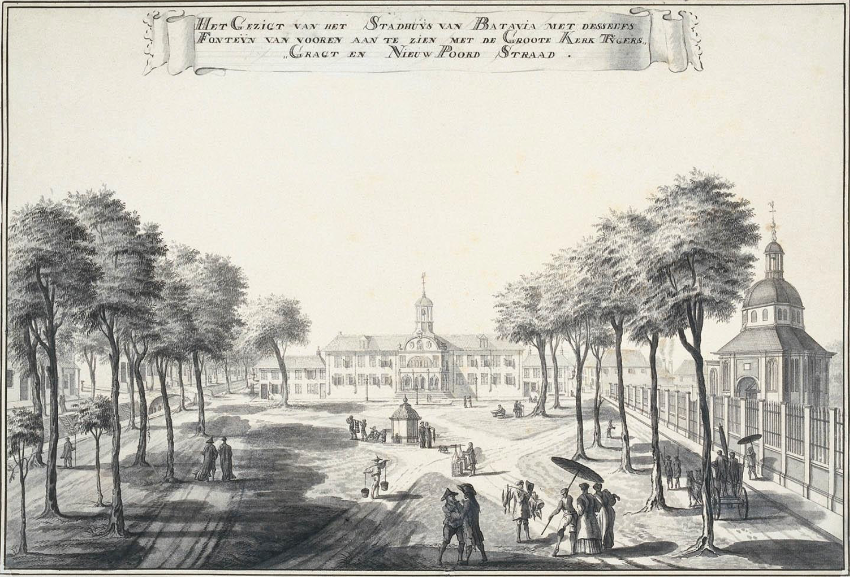
In 1790, Dul, an enslaved man owned by Johan Godfried Deebler, stood trial before the Schepenbank (Magistrate’s Court) of Batavia—a statutory body that convened in the City Hall. He was suspected of domestic theft from his master, the soldier Johannes Schmidt, to whom he was leased. This was a serious affair: domestic theft of this kind was dealt with severely. In this case, Dul was accused of unjustly taking a writing pad, which he allegedly sold to a Chinese man and pocketed the profits himself. He was found guilty by the Magistrates’ Court and received multiple punishments for this petty theft. Firstly, Dul was sentenced to public flogging, whereafter he had to return to his master, who was free to punish him further at his own desire.1 This latter form of punishment is an example of domestic authority: the ability of a pater familias (head of household) to act as the highest authority in his own household.
Households were an important political entity in early modern colonial empires. They helped colonial authorities, in this instance the Dutch East India Company (VOC), to regulate and control territories. In these households, domestic authority was an important method of operating and controlling the household. By guaranteeing the sovereignty of a pater familias, it also became easier for authorities to establish, negotiate and regulate the colonial territory.2
Even though domestic authority was an important political tool in the early modern period, historical knowledge of the different workings and manifestations of colonial domestic authority is still very limited. Court cases, such as that of Dul, offer opportunities to expand this knowledge. In these court cases, references were often made to the authority within a household. However, because court cases lie at the intersection of legal history and social history, it is a source that has been used only sparingly in general and to research domestic authority specifically.3 Own research using court cases from the Schepenbank shows that Dul’s punishment is not exceptional but occurs much more frequently. In similar cases, where an enslaved person was suspected of theft, it was almost customary for the Schepenbank to encourage the owner to impose an extra domestic punishment, by stating this in the court case. In this, we see the porosity of distinctions between private and public life and authority; even though the authority of a pater familias was domestic and private in nature, a public body such as the Schepenbank could still command the exercise of such domestic authority.
Another type of source that facilitates research into domestic authority are the Plakkaatboeken of Batavia: laws and regulations sometimes directly referred to the concept of “domesticity.” More commonly, however, domesticity was addressed indirectly via conceptions related to, amongst others, the household, (nuclear) family, and authority over enslaved individuals, children, and women. These sources again reveal how public bodies related to the VOC could enforce the imposition of domestic punishment. An example of this is when someone polluted the canal but was unable to pay the fine themselves.4 Even more striking is the legislator’s use of domestic authority, for instance, when the bailiff was allowed to impose ‘domestic’ penalties in some cases.5
Let us return to Dul now that we have a better understanding of the institutionalized practices of domestic authority. What the punishment and regulation of enslaved individuals brings into view are the contesting as well as mutually reinforcing claims of authority over enslaved and otherwise subjected individuals living in VOC territory. Yet, even though I demonstrated the commonality of such domestic punishments in this blog, we still know little about what happened after the verdict. Did Dul in fact receive a domestic punishment and, if so, what kind? How many of these acts of thievery did not end up in court? Were such acts dealt with under domestic authority? And where did private authority end and public authority start?
- NA, Schepenbank, inv. no. 11974, f.364-377, report of the trial against Dul (1790). ↩︎
- T. McGregor, L. Benton, ‘A Sea of Households: Ordering Violence and Mobility in the Inter-Imperial Caribbean’, Past and Present (2024) 22-24; M. Muravyeva, ‘A King in his own Household: Domestic Discipline and Family Violence in Early Modern Europe Reconsidered’, The History of the Family 18:3 (2013) 230. ↩︎
- K. Ward, Networks of Empire: Forced Migration in the Dutch East Indian Company (Cambridge 2008) 87. ↩︎
- J.A. Chijs, Nederlandsch-Indisch plakkaatboek, Tiende Boek 918. ↩︎
- Chijs, Nederlandsch-Indisch plakkaatboek, Seventeenth Book 43, 371. ↩︎