Britt van Duijvenvoorde, PhD Researcher, International Institute of Social History, Amsterdam //
Slave trade in Asia is slowly gaining more attention in academic and public spaces. The Exploring Slave Trade in Asia (ESTA) Database has, unquestionably, greatly contributed to increased awareness about the history of slavery in the wider Indian Ocean World both in the Netherlands as well as internationally. Since its launch in December 2023, the ESTA Database has significantly expanded in scope. Efforts by the ESTA team, collaborating projects at the International Institute of Social History (IISH), and international partners have made a new data publication possible. To celebrate the amazing collective effort, Pascal Konings (IISH) and myself, Britt van Duijvenvoorde (IISH), organized the symposium “Rethinking Horizons for Histories of Slavery in Asia” on December 12, 2025, at the IISH. The objectives of this event were twofold. On the one hand, it occasioned the second data launch of the ESTA Database and its data entry system TIDES. On the other, it provided a space to critically examine early modern slave trade in Asia and its enduring legacies in contemporary forms of slavery through the documentary screening of Slave Island together with filmmaker Jimmy Hendrickx.
The launch of the new ESTA data and entry system was accompanied by several presentations from researchers that are related to ESTA or the field of Indian Ocean slavery. Past and future data contributions to the ESTA Database were presented by Miguel Rodrigues (IISH), on the Iberian slave trade in Asia, and by myself, on the Dutch East India Company in the Bay of Bengal. Student assistants Milan Francis and Femke Brink introduced the audience to TIDES, ESTA’s novel data entry system, and presented an incredibly detailed story of a Dutch slave trade vessel which was hijacked by the Danish along the East Coast of India. Concluding the ESTA-related presentations, Bethany Warner shared the recent HTR developments at the IISH, which involves both the transcription of Dutch colonial archives as well as the construction of new HTR models for other languages. These presentations were followed by Kathleen Burke, who introduced her recent work on colonial kitchens and other places of food provision as spaces of oppression and resistance.
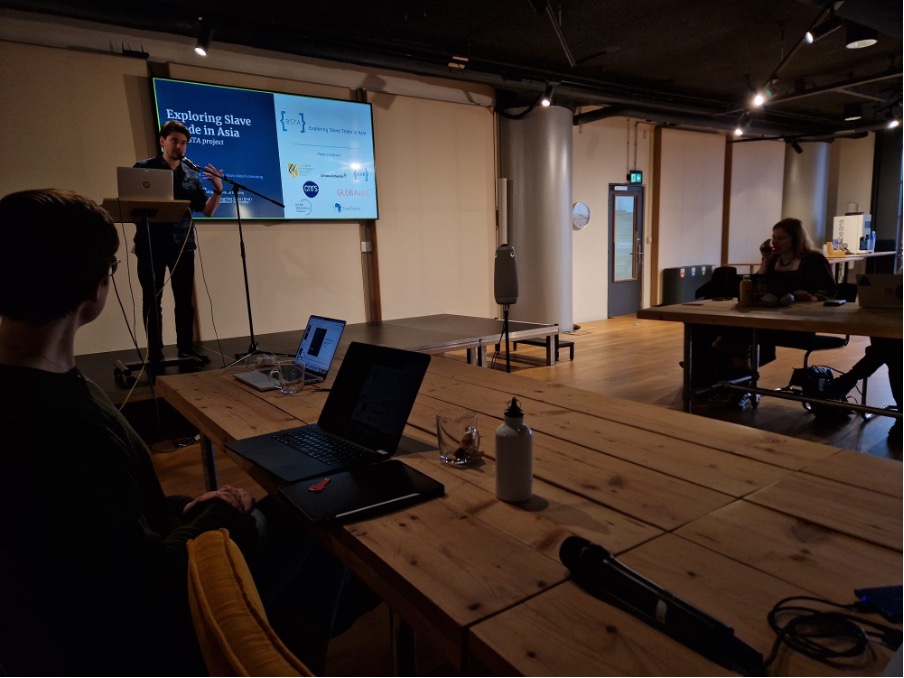
After a lunch intermezzo, ESTA coordinator Pascal Konings (IISH) officially launched the new version of the ESTA Database. In this upgraded version, the Database contains 5,292 voyages and 9,155 subvoyages and lays bare previously unrecorded slave trading patterns from newly added regions such as China, Southeast India, and Mozambique, with an increased chronological coverage into the twentieth century. In total, the ESTA Database currently contains explicit references to at least 440,000–448,000 forcedly and violently displaced enslaved people. In addition to a new version of the Database, Pascal Konings introduced the data entry system TIDES. This entry system allows users to contribute data on slave trade voyages while retaining full data ownership, and to annotate existing ESTA voyages. It was a really worthwhile experience to have worked with the ESTA team and to have colleagues like Jennifer Gaynor and Hideaki Suzuki share their reflections (and dreams!) on slave trade data, databases, and the creation of digital infrastructures.
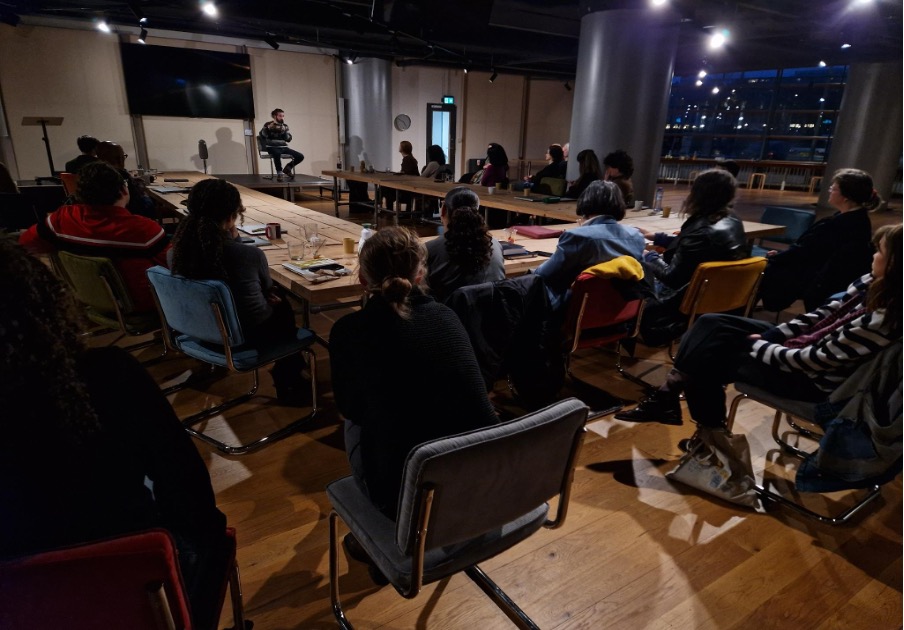
Histories of slavery are seldom connected to modern day forms of slavery. Even though contemporary labor and sexual exploitation are organized in structurally comparable ways to early modern slavery, historians all too often refrain from engaging with contemporary constructions of labor exploitation. This reverberates in the public domain, where ‘surprise’ is the main sentiment expressed when people are faced with the existence of modern slavery. To address and rethink academic and public understandings of the historicity of slavery, the second part of the event shifted focus to the present through a screening of Slave Island. This documentary follows the activist Jeremy Kewuan in his quest to eradicate modern day human trafficking on Sumba. The documentary forms a testimony to the individuals who still suffer under conditions of modern slavery whilst tracing their current-day experiences back to their colonial roots. On a more personal note, this documentary touched me incredibly in revealing the extremes of both human empathy and apathy. I am incredibly grateful that filmmaker Jimmy Hendrickx could be present during the event to discuss the documentary and the larger implications of both his movie and the realities of forced labor it depicts. In the discussion that followed, we talked about the intersections between local slavery on Sumba and commercial slave trade, both past and present, as well as topics such as gender roles in enslavement and the movie’s reception in Indonesia.
ESTA and Slave Island are projects that emerged, on the one hand, from living in the afterlife of oppression where the lives of millions of people worldwide are still marked by exploitation, and, on the other, a shared felt urgency to redress these historical and contemporary forms of violence via the dissemination of knowledge of untold histories and modern realities. Putting these two projects in dialogue with each other is, of course, not enough to fight modern day slavery—but it is one step forward in raising awareness that this fight is still to be fought.