Report | Colonial law, slavery and interactions October 6, 2025
Pepijn Trienekens, PhD candidate at the Radboud University and the IISH //
The history of slavery and colonialism receives growing attention in academic research, encouraged by a growing corpus of readily available source material through digitalization and text recognition software. Both legal and social historians have profited greatly from this process. Especially sources from colonial courts prove to be a shared ground of interrogation. Despite this common interests, interactions between us as social historians and our legal colleagues remain scarce. The workshop Colonial law, slavery and interactions organized at the International Institute of Social History (IISH) by the combined slavery research projects on 19 September 2025, provided us with a playground to share our insights on the intersections between slavery, colonial law and legal sources in the colonial archives. Eight historians shared their projects, imploring us to bridge historiographical distances towards further cooperation.
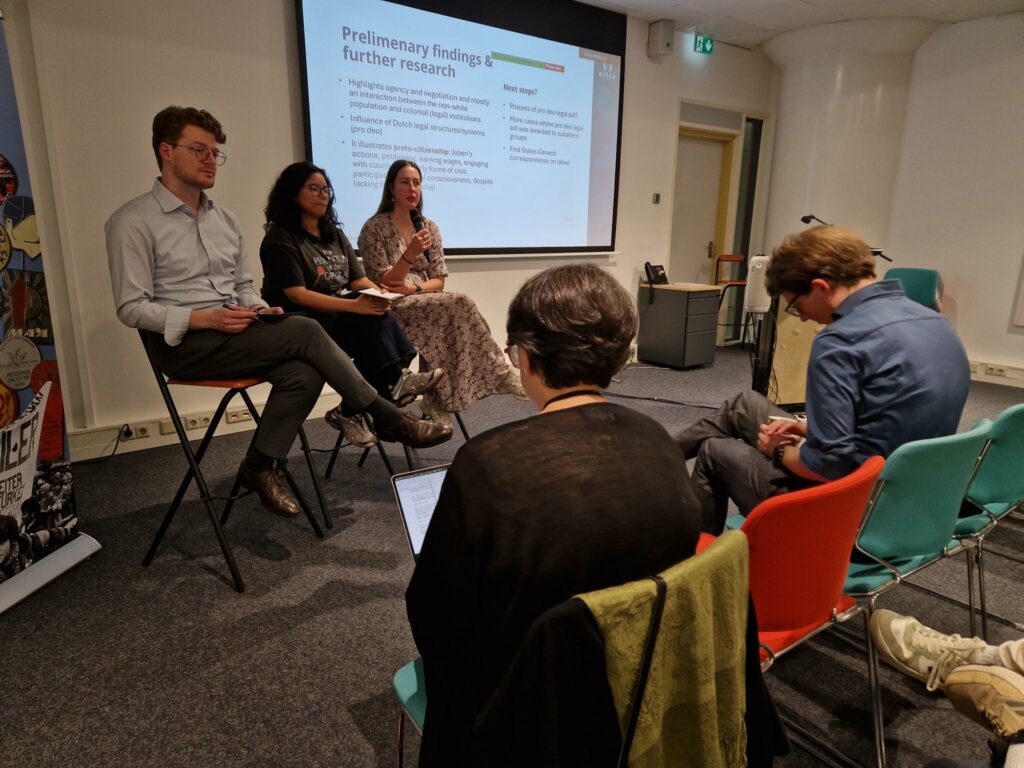
Wouter Raaijmakers, Mary-Anne Nicolaas and Ramona Negron (left to right)
A first major theme of the workshop were studies exploring differences in legal traditions, namely Hylkje de Jong from the VU Amsterdam and Timo McGregor from Leiden University. De Jong discussed the HUF-project, which looks at legal frameworks in Holland, Utrecht and Friesland to explain and connect regional variations in law and local identities. De Jong explained her long-term goal of connecting HUF to colonial archives, for which the insights shared by Mcgregor seem particularly fitting. By comparing legal practices across the Caribbean, Mcgregor argued that they are reinterpretations of shared racial and political frameworks. These common practices and values spread through migrations and the transfer of colonies between empires, showing us how legal ideas and colonial practices moved across the Atlantic world.
Jacob Giltaij from the University of Amsterdam and Wouter Raaijmakers from the Radboud University further combined concepts with governance practices. Giltaij presented the role of Roman Law in colonial Curaçao, showing that legal ordinances and decisions often reflected Roman legal ideas. However, these ideas were rarely cited literally and were frequently applied opportunistically. Expanding his focus beyond the courtroom, he found that officials, slaveholders, and the revolutionary Tula all referenced Roman law, showing its importance in colonial societies. Raaijmakers took us through the idea of legal certainty in colonial contexts. He showed that the communication of law was often deliberately vague and its implementation presented an alarming lack of formal enactment of laws. This, he argued, demonstrates the illegal and ad hoc workings of the colonial legal system.
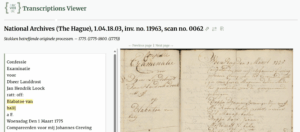
During the workshop the Early Modern Dutch Colonial Court Records database of Resilient Diversity project was launched. In their presentation of the dataset, Elisabeth Heijmans (IISH) and Sophie Rose (Leiden University) provided us with a bridge between the mostly conceptual legal-focused talks to approaches including individual experiences by introducing a database of court records from the WIC and VOC archives. This digital goldmine offers direct access to criminal and civil sources, opening new possibilities in researching legal practices and individual experiences, and proves a particularly relevant resource for all academics attending.
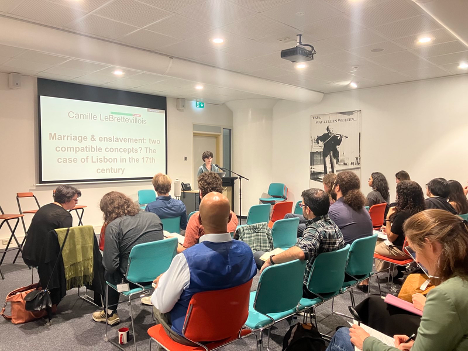
Joining in the theoretical bridge-building between our disciplines, Camille Le Brettevillois and Filipa Ribeiro da Silva of the IISH combined perspectives and actions of enslaved individuals with legal theories. Le Brettevillois talked us through marriage and slavery in seventeenth-century Lisbon. She explained how canon law, granting marriage as a right to all ‘good’ Christians, clashed with property rights over enslaved individuals. She emphasized that enslaved people were aware of their religious rights as they often mobilized networks of witnesses to their Christendom. In her presentation, Ribeiro da Silva flipped the top-down narrative of colonial law by showing how revolts and resistance shaped Portuguese legislation on slavery, demonstrating that these laws were responses to both the needs of lawmakers and actions from below.
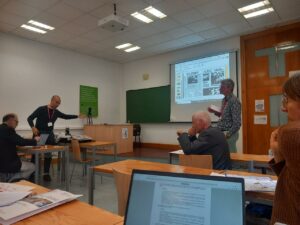
Camille Le Brettevillois presenting “Marriage & enslavement: two compatible concepts?”
Finally, Ramona Negron and Mary-Anne Nicolaas of the KITLV shared their project How Slaves Became Citizens through case studies on legal agency of (illegally) enslaved people. Negron presented the story of Johanna. She was a free-born woman in Demerara who, after more than a decade of illegal enslavement under her adoptive guardians, successfully petitioned the colonial government for her freedom. Nicolaas introduced us to Jaberi, an enslaved woman in Suriname. Despite previously being informally manumitted, she was later abducted, imprisoned and claimed by a descendant of her deceased owner. After obtaining legal representation and navigating the court system, Jaberi was released and also able to petition her freedom. Johanna and Jaberi tell us much about subaltern experiences of colonial law on Demerara and Suriname. They show us the social status and rights-awareness of orphans and people of mixed descent in the Dutch Atlantic, and also the practices of shifting boundaries between enslavement and citizenship-rights.
Summing up the day, the importance of legal sources for social historians and for our legal colleagues is clear. The contributions showed how colonial law is not created in isolation but through continual negotiation, and that legal practices mattered more than merely the written law. To work towards a more complete picture of the creation, workings and uses of laws in colonial society, which is urgent for the study of slavery and colonialism as well as the history of law, we need both legal and social historians. Furthermore, as called for in the plenary discussion, we need to take indigenous legal traditions into our considerations and move away from a Eurocentric perspective focused only on colonial law imposed by European colonialists, but rather to see the impact of interactions between colonizers, colonized and otherwise affected societies.
Report
Report | DH2025 Lisbon: Accessibility and Citizenship August 13, 2025
Bethany Warner, Junior Researcher, International Institute of Social History, Amsterdam //
On 14th to 18th July, the Alliance of Digital Humanities Organisations (ADHO) hosted its annual Digital Humanities conference at NOVA, Lisbon. The conference, with the theme of “Building Access and Accessibility, Open Science to all Citizens” explored a wide range of digital humanities themes, methodologies, and disciplines. Across 2 workshop days and 3 days of conference, researchers presented a huge diversity of topics and methodologies to approach humanities subject, from LLM integration in research workflows to image analysis in historical newspapers and more, conducted in a way which furthers the conference aims of furthering access, open science, and accessibility.
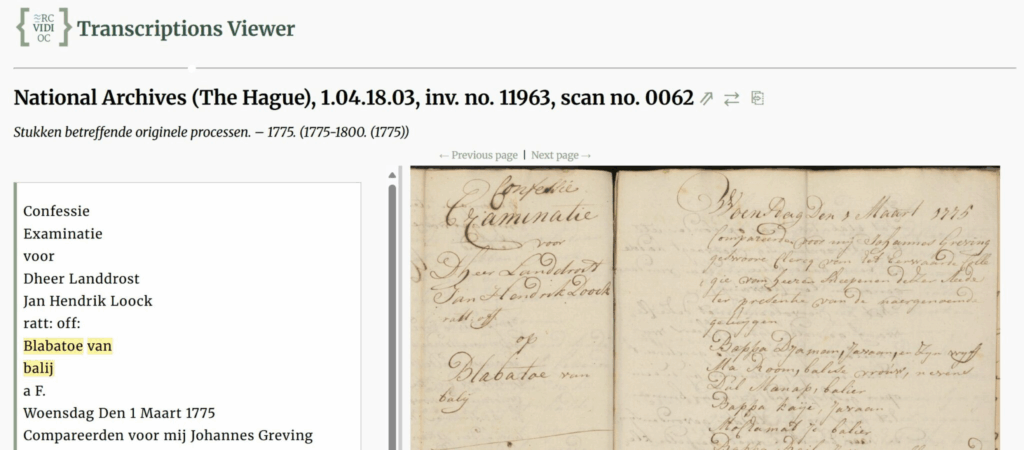
As part of the Voices project group, my work consists in creating handwritten text recognition (HTR) for colonial sources and slavery studies. This involves creating HTR models which make it possible to automatically transcribe historical documents—significantly advancing new avenues of historical research. At the conference, I had the opportunity to present our progress using Loghi, an open-source HTR tool developed at the KNAW. So far, we have successfully transcribed over half a million pages of colonial archival material, including from the Dutch East-India Company (VOC) archives. In addition, we have developed an HTR model for early modern Portuguese, with models for other languages currently underway. The resulting HTR makes the material searchable for the first time ever and opens the door for different kinds of computational and non-computational historical research.
HTR is a complex computational task due to language differences and the huge array of handwriting styles across time and space. This challenge has been taken up and explored by researchers across the world as machine learning models are rapidly improving. At the conference, I had the opportunity to engage with other presenters working on solutions to complex computational tasks such as abbreviations, multidirectional text and detecting authors by minute character differences. Many of these methods and tools being developed in an open-source manner, contributing both separately and collectively to efforts to make archival material more accessible. By using open-source tools, and by ultimately publishing our models, we hope to similarly contribute to this call.
Report
Report | DH Benelux 2025 July 2, 2025
Bethany Warner, Junior Researcher, International Institute of Social History, Amsterdam //
The 12th edition of the Digital Humanities Benelux conference took place last week at the Vrije Universiteit (VU) in Amsterdam. The DH Benelux conference is one of the main venues for disseminating research and exchanging ideas within the community of interdisciplinary Digital Humanities research.
As we explore digital methods to further our research on slavery and resistance to it, members of our project team (Britt van Duijvenvoorde and Pascal Konings) collaborated with colleagues at the Huygens Institute (Rick Mourits, Thunnis van Oort and Kay Pepping), to present their work, Modelling the enslaved as historical persons: Extending the Persons in Context (PiCo) model to fit a 19th century slave society.
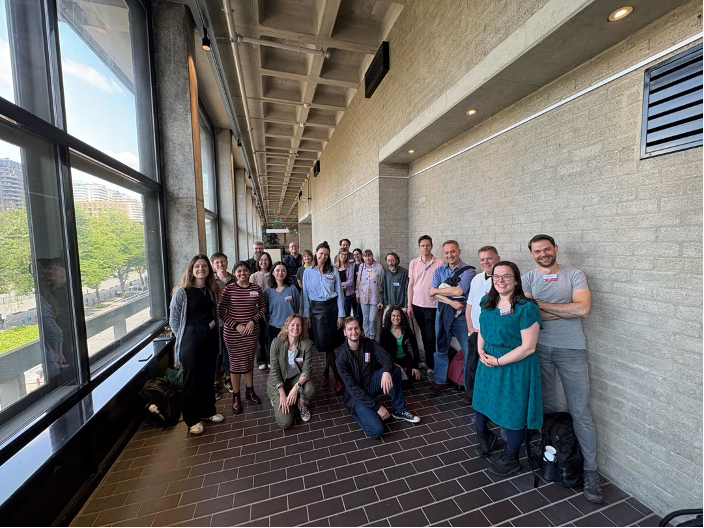
Members of the Humanities Cluster at DH Benelux
This presentation illustrated extensions to the PiCo data model to provide more accurate depictions of the relationships existing in colonial societies and the changing nature of social status. This can include someone’s statement related to ‘freedom’, relationships of ownership and enslavement, but also to look for other identifying traits for enslaved people beyond their relationship to enslavement, such as person names and changing statuses.
Report | Congress on the History of Families in Albacete, Spain June 23, 2025
Nicholas Sy, assistant professor at the Department of History, University of the Philippines Diliman and External PhD candidate, Radboud University //
Photo by co-panelist, Matthias Rosenbaum-Feldbrugge
Nicholas C. Sy and Eva Maria Lehner broke off from the group who went from Amsterdam to Bonn and, ironically, went from Bonn to Spain for a Congress on the History of the Family. The event was attended by hundreds of historians from primarily Hispanophone but also Anglophone, Francophone, and Lusophone worlds. Nicholas and Eva presented in a two-part panel “Slave family formation in Latin America, Africa, Asia and Europe” organized by prof. Dr. Jan Kok from Radboud University Nijmegen.
Far from quixotic, these back to back panels in La Mancha presented empirical results from large early modern databases, leading to comparative discussions over matters like levels of illegitimacy, child abandonment, and child mortality among the enslaved in Brazil, the Caribbean, the Spanish peninsula, the South African coast and the rest of the Indian Ocean World. Why, for example, were levels of illegitimacy so much higher in the Iberian peninsula and the Iberian Americas than in Iberian Asia? The dynamic discussion was done in both Spanish and English. The congress’s use of Microsoft PowerPoint’s translated subtitling tool was intermittently unsuccessful (misquoting one presenter as being a specialist in Birds and in the World of Warcraft), but no supplementary charades were necessary as some participants translated for others.
What was wonderful about this conference was that Nicholas, for example, was able to watch a panel in Portuguese about the record linkage of large Brazilian databases, which reminded him a lot about the IISG’s own efforts to create and link the same for the Indian Ocean World. After several days in a row of paella and too much ham, Nicholas and Eva left the surprising cold of Spain to return to the warmth of Western Germany.
Report
Report | ESTA Network Workshop: Bonn 2025 June 16, 2025
Pascal Konings, PhD Researcher and ESTA Project Coordinator, International Institute of Social History, Amsterdam //
On May 9th 2025, the ESTA network workshop “From slave trade to contract labour and shipping in Asia: Digital methods and collaboration” was held at the Bonn Center for Dependency and Slavery Studies (BCDSS), as part of the larger conference “Strong Asymmetrical Dependencies: Perspectives from Asia”. This workshop built on discussions about the reconstruction of the slave trade in the wider Indian Ocean world that have taken place in various settings over the past decade. While international collaboration was set in motion with the design and implementation of the ‘Exploring the Slave Trade in Asia’ database project initiated by the International Institute of Social History, new questions have emerged and new initiatives have joined the field. Some are still in development, while others have been realised thanks to national and European funding schemes. So, the aim of this workshop was to bring together current initiatives and ongoing projects to discuss common issues, with a specific focus on conceptual and digital challenges.
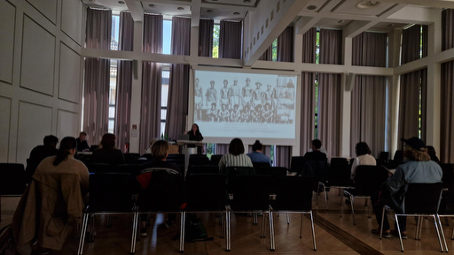
Workshop Bonn, May 9th 2025
During the workshop, presenters that are involved in these initiatives reflected upon conceptual and historiographical challenges of projects such as the Pacific People Trading Database (Emma Christopher, UNSW), the Global Business of Slave Trade (Filipa Ribeiro da Silva, IISH) and the China Human Trafficking and Slaving Database (Claude Chevaleyre, CNRS), as well as topics like slaving in Macao (Philipp Huber, IISH) and the eastern Indonesian Archipelago (Hans Hägerdal, Linnaeus University). The presenters shared their perspectives on developments and on how various coerced labour regimes could be studied. Then, more project presenters followed, who focused on the ‘toolbox’ – or practicalities – of their initiatives. For example, Brecht Nijman (Huygens Institute) discussed preliminary work on a database of intra-Asiatic shipping, while our very own Britt van Duijvenvoorde (IISH) showed her research on slave trade on the Coromandel Coast in the 17th and 18th centuries. The ESTA project itself was represented by this author (IISH) and Aleksandra Modelina (BCDSS), who discussed the history, goals and future of the project, with Aleksandra focusing on ESTA’s new data entry interface and her experience working with it.
After a well-deserved lunch, the attention shifted to Susana Münch Miranda’s project Reassessing Global Trade: Eurasian Trade via Lisbon, 1770-1830, or EURALIS (NOVA University Lisbon). In a similar vein, George Bryan Souza (University of Texas, San Antonio) joined online to talk about his work surrounding Portuguese Asiatic Shipping: Outward, Homeward and intra-Asian Voyages, c. 1668 to c. 1842, while sharing source material he based his research on, as well as the archives that contain them. When Alexander Ermakov (Bonn Center for Digital Humanities) shared his valuable feedback on the projects, a lively discussion emerged on the state of the field of digital humanities, including the challenges as well as opportunities that the latest digital methods bring to the field of (global) slavery studies – think for example of the use of artificial intelligence to extract large-scale slave trade data from colonial source material, while such a scale simultaneously complicates manual data curation. Ways to start new collaborations and strengthen existing ones were discussed; its importance was echoed by many.
More information about the ESTA project can found here.